Sunday, November 22, 2015

The Magic Paintbrush

Continuing our discussion on Ancient China, one of our recent stories was a Chinese Folktale titled The Magic Paintbrush. 
Ma Liang is a poor orphan who dreams of becoming a famous painter, but does not have a paintbrush to paint. In a dream one night, the young artist is given a magical paintbrush. He goes on to amaze onlookers as his artwork becomes real and leaps from the paper.When news of this spreads, the young boy finds himself at the hands of the emperor, whose interest in the paintbrush is driven by greed.The emperor commands the boy to paint him a room full of riches. Ma Liang knows in his heart that it would not be right to paint such a thing. Instead, he paints a tree of gold on a solitary island in the middle of a sea. He paints a boat for the emperor to travel to the island, and he paints wind to fill its sails...and more wind...and more wind. The emperor is blown away, learning the lesson that those who rule and paint with greed in mind don’t deserve.


Each student was given a piece of paper with water colors. They were to imagine that they had the magic paintbrush. Whatever they painted would become real! What would be something you would like to have that could become real?
Students painted some very creative ideas! 
More pets, castles, endless amounts of books, large bowl of chocolate pudding, more stars in the sky, parts for their bike, etc.

The next day, we wrote about our paintings!
Students met with a partner to chat about their paintings and ask questions to expand their ideas about why they painted what they did. Those ideas were used to begin their drafts. 
Why did you paint that picture with your magic paintbrush or what would you have Mai Liang paint you? 
Why? Students followed with complete sentences to give reasons for why they painted their pictures. 


These will be coming home soon. However, first we want to enjoy them in the classroom to share with one another. We will be creating a museum of Mai Liang inspired paintings and writing for students to show, and and for others to walk through and view. 
We get to celebrate our writing and continue our conversation connected to Ancient China!

Spelling Bees!

This past week we began Unit 3! Our reader Bedtime Tales from Unit 2 has concluded and now we are moving into a new reader with Unit 3 titled Kids Excel. This book is written as a magazine, with all stories written as articles. However, all characters in Kids Excel are fictional, so we are are reviewing the genre of Realistic Fiction. 
One of the stories we had more of an introduction conversation about was The Spelling Bee. Before we read The Spelling Bee, we checked everyones prior knowledge about the even of a spelling bee, by creating a KWL chart:
K: What do you already Know about spelling bees
W: What do you Want to know about spelling bees
L: What did you Learn about spelling bees
Students were very curious about what happens at spelling bees and had many questions they were hoping to get answered. The L (what was learned) was only after one part to a two part story. 
Part one: The Spelling Bee
Part two: Then There Were Two


Monday, November 16, 2015

Little Change...

Reading Fluency
I have modified the homework just a little. You will see coming home today a new type of reading fluency activity, to replace the one paragraph passage. The new passages give more of a challenge, with added activity and a whole lot more engagement to commit to throughout the week. The other bonus this fluency has is that is similarly related to Six Minute Fluency that we do in the classroom. Which means directions on the necessary process are not included, and instead the students can teach you an aspect of their day that they are now bringing home. They will only need your help to time their fluency for one minute and to also identify words read incorrectly. The students should be able to take care of the rest! 
I ask that they try to do this each night. They have a small chart to fill in each read, to record total words read correctly and incorrectly for Monday through Thursday. Today students jumped to see if there last read could be Friday morning before they come to school...of course!! 
There are also three comprehension questions on the back that students need to answer with complete sentences and return each Friday. 
There are two columns on the graphing chart, to record and track results. The first column above the assigned passage is their first read (Monday). The second column is their last read (Thursday - or Friday). This is a record for the students to keep at home. The graph does not need to be returned to school. Just the fluency passage/comprehension questions.

Spelling
New spelling words including r-controlled sounds are coming home.
/er/
/or/
/ar/
The story Kids Excel, that is mentioned in the spelling note, will be coming home Tuesday night instead of Monday night.

Thank you for all your continued help and support at home!!

Sunday, November 15, 2015

Ancient China

We have moved across the continent of Asia from Ancient India into Ancient China.
Together as a class we created our own maps of Asia. This helps students use their map skills and to also use as a resource to locate the different regions we are in, and to also follow where we are moving. We also have a globe in our classroom to see the connection of Asia to other parts of the world!
Our first lesson focused on the Yellow and Yangtze Rivers.
We covered topics such as:
The Yellow River with silt
The Yangtze River and the rice fields
Farming along the rivers and in the rice fields
Chinese inventions
Ancient Chinese city settlements
Ask your child why the Yellow River is yellow?
Why is the Yellow River called the "Mother River" and "China's Great Sorrow?"
What name did the area along the Yangtze River get due to the fertile soil?
 The lesson to follow was on the Ancient Chinese form of paper, writing and calligraphy
Topics we discussed included
Chinese characters
Understanding the writing system used in ancient China and today
Writing on bone, hemp paper, and bamboo writing tools
Learning about inventor Cai Lun (invented a form of paper)
The Chinese printing workshop
Calligraphic Art
Ask your child if it was easy for Chinese to get copies of books? Why or why not?
Next lesson to come...A Chinese folktale The Magic Paintbrush

Book Reports

In the classroom we have been working tirelessly on our writing plans! We continue to work on narrative writing, using our readers to create book reports. Stories we have read are summarized and retold through our books reports in sequential order. Students are recalling characters, setting, plot, and moral (depending on the genre). 
They began by planning and laying an outline for what their paper will include. 
Students use their plan to then create drafts. This is where they use their writing goal pages to ensure they have all elements added into their writing, and to continue strengthening the structure of their writing.

 When their drafts are complete, an editing check-sheet is provided to use as a tool to edit the work they have done. This time, we added in an extra edit with a peer. Peer review! Students were paired up to exchange drafts, where their partner read through their work using the same editing check-sheet to give their help and support. This gave their paper another pair of eyes, with new and different ideas and helpful hints to improve their writing. 
LOVE those papers that have arrows, side notes, sentences crossed out, and carrots added! Shows the hard work of revising!
In addition, we learned that many authors from some of our favorite books edit their writings MANY times before turning it into a final copy! We used these authors as mentors when we thought our writing was done. 

Sunday, November 8, 2015

Reading Time & Story Maps

Students are working their way through Unit 2: Bedtime Tales, where they are quickly approaching the end.
One part of unit two skills, is reading time with new stories and comprehension activities as part of many lessons. Students apply different phonics skills learned in lessons leading up to a variety of stories where those concepts would apply. My introduction to the stories reminds students of these learned concepts pointing out different examples, but also letting them read through new texts to practice independently while strengthening their reading ability.  
We are learning many elements within fictional tales. After each story, one practice for comprehension is to complete a story chart (like above). They review setting, characters, plot (beginning, middle and end), and occasionally moral, along with recognizing the different genres for each story. Students try this individually at first, then get with their reading partners, while always ending with a whole group conversation filling in the chart together. This gives me the opportunity to see how students do independently where I can listen to their level of fluency and where they are applying learned reading skills and strategies. It also shows where some students could be struggling, to then further assist. At the same time, I also get a peak at what students are interpreting on their story maps for the setting, characters, plot, and sometimes moral. 


Subtracting three digit numbers

In the midst of chapter 3!
Lessons within this chapter include:
Subtracting three digit numbers without regrouping
Subtracting three digit numbers with regrouping in the ones, tens and hundreds (three separate lessons)
Subtracting three digit numbers across zeros
Students will:
Use base ten blocks to subtract three digit numbers with and without regrouping
Apply a variety of strategies to solve subtraction problems
Solve parts of the problem using mental math
Apply the inverse operation of addition and subtraction
Solve real world subtraction problems
Thinking Skills & Problem Solving Strategies
Deduction - working and counting backwards
Identifying patterns and relationships
Using a diagram and/or model

Wednesday, November 4, 2015

Sunshine Buddies

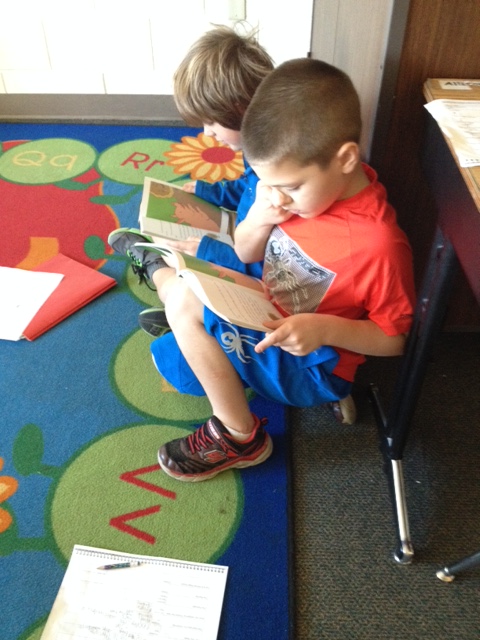
The weather was so nice yesterday and today that we took reading to our fourth grade buddies and our classroom buddies outside!
Amazing weather makes everyone happier!!


Monday, November 2, 2015

Math Review

Each afternoon students are involved in a math activity called Math Review. This is a short period of time where the students complete four different math concept area problems. Some or all concepts are different each week, depending on their level of understanding as a whole by Friday.
Students practice selected concepts Monday through Thursday, then test on Friday. This is their time to apply what they know, use the necessary resources of our classroom, ask their group members at their tables, and find the necessary tools to help further their knowledge towards each concept. After 10 minutes, all work is gone over as a whole group where students explain how to solve problems in different ways, correct errors, and possibly form small math discussions from any questions or connecting comments. In the end, students star all work that is done correctly, and add up their total. From there they set a goal to achieve for the next day. This way they are able to set realistic goals for themselves, see their growth and also track their results. 
This weeks concepts are
1. Elapsed time
What time will it be 10 minutes before 1:10?
2. Fractions
Shade in 1/4 of the circle
3. Two step story problems
There are 6 cars with 4 tires each. If 8 tires fell off, how many tires are left?
4. Three digit (or more) subtraction or addition including the inverse operation
 
When students are completed with Math Review and waiting for the fellow peers to finish they can:
Work on their skill ability math packet
Do selected challenge problems available
Choose a math activity from Math Workshop
Always busy!!

Homework

Homework is a bit thinner this week. With the short week and the Westwoods Family Fun Night at Incredible Mo's on Wednesday night, I know there is a time crunch to fit it all in. 
Math Page
Fluency Passage
Read for 25 min.
Spelling
There will be spelling this week. The concept of contractions is not a new concept to our classroom, and something we have been working on sporadically over the last couple of weeks. Taking two words to blend with an apostrophe. We will have our spelling test on Thursday this week. 
In addition to the students studying at home, in the classroom they will be reading contractions in different stories in Bedtime Tales to see the proper use, as well as applying contractions to different activities and using in our writings.
Ask your child to not only spell the contraction, but can they use it in a sentence appropriately?
Please let me know if you have any additional questions or concerns!